Blog
The OpenVisio Blog
Field notes on working with AI coding agents as teammates — shared workspaces, tickets, review — and on giving them the codebase context they need without burning tokens on the whole repo.
- GuideOctober 8, 20269 min read
Shared Workspaces for Humans and AI Agents (2026 Guide)
Coding agents can now take a ticket to a pull request. The question is no longer which assistant to use, but where people and all their agents meet. A field guide to the category.
Read more - GuideOctober 8, 20267 min read
How to Assign Tickets to Claude Code and Codex as Teammates
The step-by-step workflow for turning a coding agent on your laptop into a team member that takes tickets, publishes a plan and opens a PR — plus what belongs in the ticket.
Read more - AnalysisOctober 8, 20267 min read
Atlassian's Agentic Multiplayer Protocol for Small Teams
Atlassian just said agents should work like employees, with assigned identity, authority and scope. The idea is right. Here is what it means if you are eight people and not on Jira.
Read more - GuideOctober 8, 20268 min read
Human-in-the-Loop for AI Coding Agents Without the Drag
Review is where agent productivity goes to die, unless the controls are designed. Four structural controls, one review loop, and the anti-patterns that turn oversight into a bottleneck.
Read more - AnalysisOctober 8, 20268 min read
AI Project Management for Software Teams: What Changes
There is a difference between an AI assistant inside your PM tool and agents that actually take tickets. The second changes how you plan, what a board shows and how you measure delivery.
Read more - GuideSeptember 4, 20266 min read
AI Codebase Context: A Practical Guide for Better Coding Agents
A coding agent is only as reliable as the context it receives. This practical guide explains what useful repository context contains and how to deliver it efficiently.
Read more 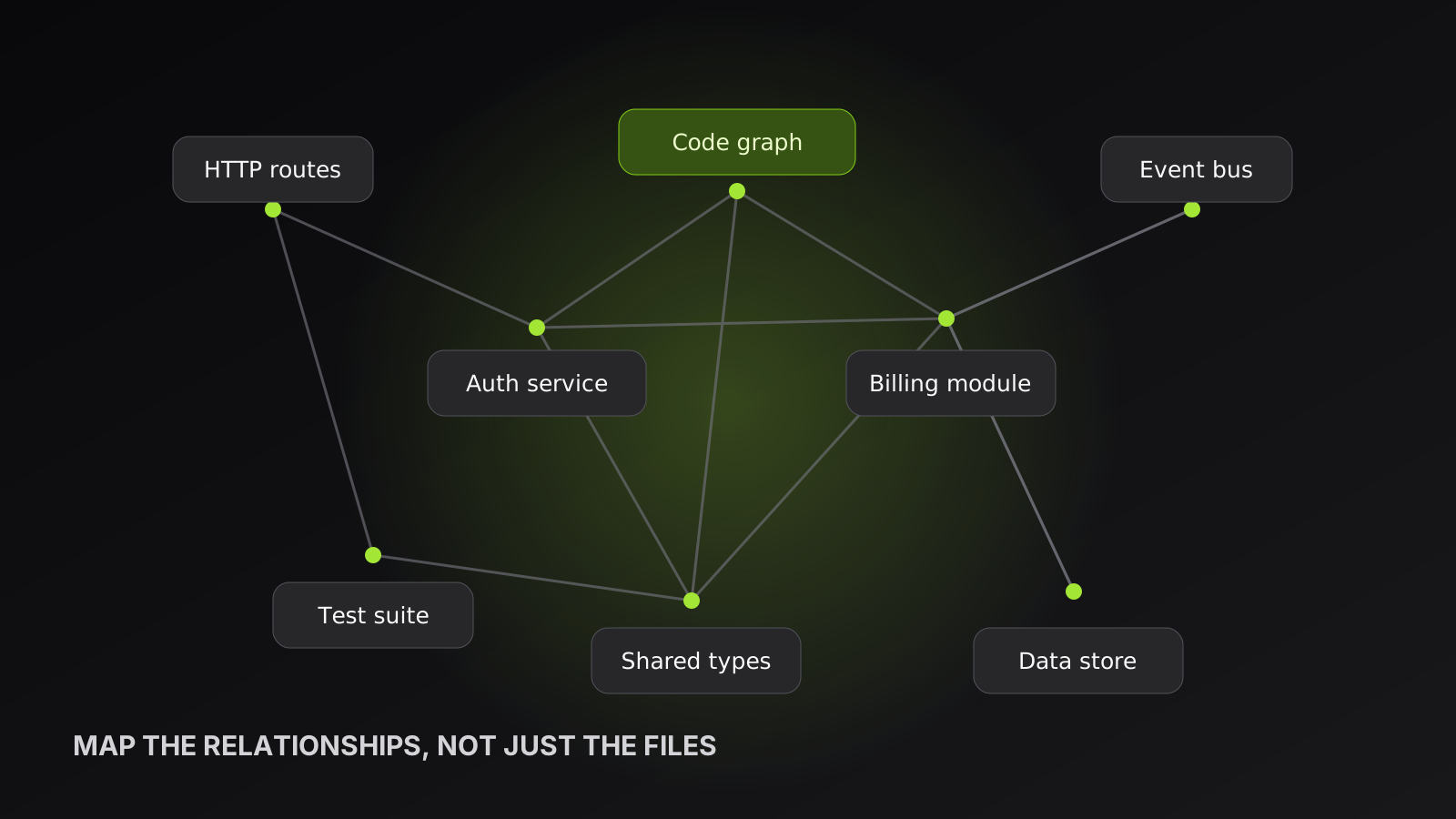 ArchitectureSeptember 3, 20266 min read
Codebase Visualization: How to Map a Large Repository
A useful codebase visualization is more than a directory tree. It shows the relationships that explain ownership, execution, risk, and change impact.
Read more- MCPSeptember 2, 20266 min read
Using an MCP Server to Give AI Agents Codebase Context
MCP gives coding agents a standard way to ask external tools for context. A code graph server turns vague repository exploration into precise structural queries.
Read more - EngineeringSeptember 1, 20265 min read
Software Impact Analysis Before a Large Refactor
Refactors fail at the edges: an overlooked caller, serialized field, plugin, or test fixture. Impact analysis makes those edges visible before code changes.
Read more - TeamsAugust 31, 20266 min read
How to Onboard Developers to a Large Codebase Faster
The fastest onboarding does not explain every subsystem. It gives a new developer a reliable map, one end-to-end workflow, and a safe first change.
Read more - Deep diveAugust 27, 20265 min read
Code Knowledge Graph vs. Embeddings: Which Grounds an Agent Better?
Embeddings retrieve by resemblance; a graph retrieves by relationship. For questions like “what breaks if I change this?”, only one of them is answering the real question.
Read more - PlaybookAugust 26, 20265 min read
Five Ways to Cut Your AI Coding Agent’s Token Bill
Token bills balloon because agents re-read the same files to answer overlapping questions. Here are five concrete levers, in rough order of impact.
Read more - FundamentalsAugust 25, 20266 min read
How AI Coding Agents Actually Understand a Codebase
Under the hood, most agents explore a repository the same way a new hire with no map would: open a file, read it, open the next. That’s where the tokens go.
Read more