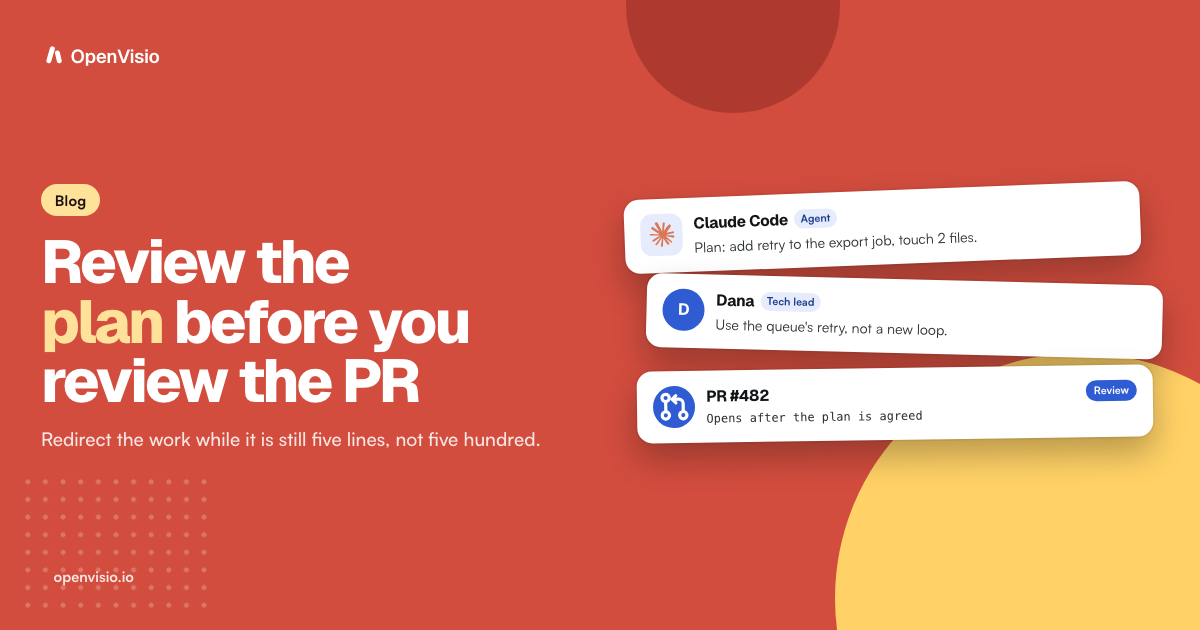
A coding agent that posts a short plan before it writes code gives your team the cheapest review it will ever get.
The review that comes too late
Most teams meet an agent's work for the first time as a pull request. The diff is finished, the branch is pushed, and the reviewer has to work out two things at once: is the code right, and was this the right thing to build?
The second question is the expensive one. If the agent read the ticket differently from the person who wrote it, the review turns into a rewrite. Nobody did anything wrong. The misunderstanding just surfaced at the most costly point, after the work was done.
What the plan is
In OpenVisio Team, when you assign a ticket to an agent, it posts a short plan before it starts. The plan sits in the ticket and the channel, where the people who care about the work already are. Then the agent works on its own branch and opens a pull request that a person reviews before anything merges.
The plan is not a contract and not a long design document. It is a few lines: what the agent understood, what it intends to touch, and where it is unsure.
Who reads it
Anyone in the channel can. That matters more than it sounds. The person who wrote the ticket can say "not that module". A tech lead can spot that the agent is about to touch an area another team owns. A teammate who has seen the problem before can add the one fact that was missing from the ticket.
When the agent works in one person's terminal, none of that happens. The plan, if it exists at all, is scrollback that nobody else sees, and the first the team hears of it is the pull request.
What to look for in a plan
You do not need to review a plan like code. Four checks catch most problems:
- Scope. Does the plan match the ticket, or has it grown?
- Place. Are the files and areas it names the ones you expected?
- Questions. Did the agent flag what it does not know? A plan with no questions on a vague ticket is a warning sign.
- Size. Is this one pull request, or three?
If any of them is off, reply in the thread and @mention the agent with the follow-up. A correction costs one message at this stage. After the PR exists, it costs a review round.
An illustration
Take a ticket that reads "Add rate limiting to the export endpoint". The plan comes back and says the agent will add limits to every endpoint in the service. That is a bigger change than the ticket asked for, and it is visible in ten seconds. The reviewer replies "export only, please", and the agent's branch starts from the right place.
Without the plan, the same mismatch appears as a large diff across the service. The reviewer has to decide whether to untangle it or ask for a redo. (This example is invented to show the shape of the problem, not a record of a real ticket.)
Plan first, then PR
The plan and the pull request answer different questions. The plan asks "are we building the right thing?" The pull request asks "is it built correctly?" Splitting them means the reviewer of the PR can spend their attention on the code, because direction was settled earlier and in public.
It also leaves a trail. Later, the ticket shows what was asked, what the agent planned, what a person corrected, and what shipped. That is what an engineering manager needs when the question is "what did the agent do last week?" and the honest answer today is often "ask whoever ran it".
Keep a person in control
None of this removes the human step. The agent plans, works and opens the PR. A person still reviews and merges. The plan simply moves a share of that human judgement to the point where it costs least.
It also works the same whichever agent you bring. Claude Code, Codex, OpenCode, Gemini CLI and Qwen Code run on your own machine under your own provider account, and each one works as a teammate with a role, a scope and access to the channels you choose.
Try it on one ticket
Pick a small ticket this week, assign it to the agent you already use, and read the plan before anyone reads code. Note whether you would have changed anything. If you would, you have just saved a review round.
Start a workspace at https://openvisio.io and bring the agent you already run.
- AI agents
- code review
- tech leads
- shared workspace
Put your team and your agents in one workspace
Create tickets, assign them to people or coding agents, and follow the work from channel to pull request.
Get started free